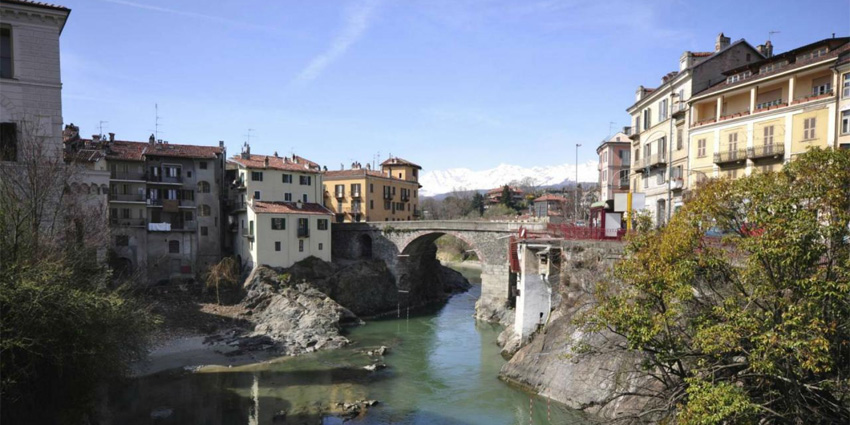
Ivrea, a city shaped by water and stone
Located in the heart of the Canavese region in Piedmont, Ivrea exists in a delicate balance between nature and human history.
The Dora Baltea is more than a river here—it is a living presence, reflecting the changing skies, the bridges, and the daily rhythms of the city. Its sound accompanies walks through Ivrea, offering a sense of continuity and calm.
The surrounding hills and distant Alpine profiles frame the city with a natural elegance. Nature is never far away, and even within the urban landscape, it feels close enough to touch. This harmony gives Ivrea a rare sense of breathing space, where the environment and the city grow together.
The historic center and the weight of time
Walking through Ivrea’s historic center is like stepping into a layered story. Narrow streets wind between stone buildings worn smooth by centuries of passage. Every corner feels intimate, every façade holds traces of different eras. There is no rush here—Ivrea invites slow steps, attentive eyes, and moments of quiet observation.
The past does not feel distant or museum-like. Instead, it lives in subtle details: an archway opening onto a small square, a window overlooking the river, the uneven rhythm of cobblestones underfoot. Time in Ivrea feels accumulated rather than lost.
The castle and the language of silence
Rising above the city, the Castle of Ivrea stands as a quiet guardian. Its red brick towers are unmistakable, yet never overwhelming. The castle does not dominate the skyline so much as anchor it, offering a sense of permanence and protection.
At sunset, the castle takes on a softer presence. The light warms the walls, and the city seems to pause. Sounds fade, thoughts slow, and the silence becomes meaningful rather than empty. It is in moments like these that Ivrea communicates most clearly—not through words, but through atmosphere.
Ivrea and the Olivetti vision
One of Ivrea’s most distinctive identities lies in its modern history, closely tied to Olivetti. The industrial buildings, residential areas, and social spaces designed for workers form a unique urban landscape, now recognized as a UNESCO World Heritage Site.
These structures are not just architectural landmarks; they embody an idea of society where innovation, culture, and human dignity coexist. Walking among these buildings, there is a quiet sense of respect—for work, for community, for the belief that progress should improve lives rather than consume them. This vision still resonates, giving Ivrea a thoughtful, forward-looking soul.
The Carnival and shared emotion
Once a year, Ivrea transforms completely during its historic Carnival. The famous Battle of the Oranges fills the streets with color, sound, and raw energy. It is an event that overwhelms the senses and dissolves boundaries between participants and spectators.
The air becomes thick with movement and emotion. Laughter, tension, tradition, and release collide in a powerful collective experience. Beneath the spectacle lies something deeper: a ritual that binds the community together, reaffirming identity through shared intensity and celebration.
Lakes, landscapes, and quiet escapes
Beyond the city center, Ivrea opens onto a gentler world. The surrounding countryside, dotted with hills and the Five Lakes of Ivrea, offers moments of stillness and reflection. These bodies of water mirror the sky and trees, creating spaces where thought slows and attention turns inward.
Here, nature feels restorative rather than dramatic. Paths invite wandering, pauses feel natural, and silence becomes a companion. The proximity of these landscapes gives Ivrea a rare balance—urban depth paired with immediate access to calm.
A city that stays with you
Ivrea does not seek to impress. It does not compete for attention or demand admiration. Instead, it leaves traces—emotional impressions that surface later, unexpectedly. A memory of light on water, the echo of footsteps in a narrow street, the feeling of standing still while history flows quietly around you.
It is a city that remains, not as a single image, but as a collection of sensations. Like the Dora Baltea, Ivrea continues to move gently within memory—steady, reflective, and deeply human.