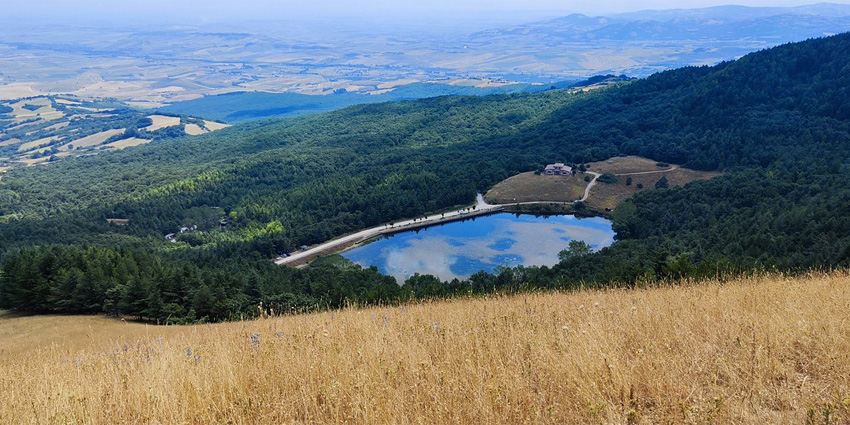
Lake Pescara: An Emotional Journey Through Water, Silence, and Identity
There are places that do more than simply exist — they breathe, they listen, they hold memory. Lake Pescara is one of them.
Nestled in the heart of Abruzzo, just a short distance from the city of Pescara, this stretch of water embodies a delicate balance between landscape, identity, and quiet reflection.
To speak about Lake Pescara is not merely to describe a body of water. It is to enter a space where light becomes language, where seasons rewrite the horizon, and where time seems to slow its relentless pace. Here, nature does not perform — it reveals itself gently.
Where Lake Pescara Is Located
Lake Pescara lies within the fluvial system connected to the Fiume Pescara, the river that crosses the Abruzzo region before flowing into the Adriatic Sea. This relationship with the river gives the lake a subtle vitality. The water is never truly still; it carries the quiet pulse of movement, shaped by currents that whisper rather than roar.
Its proximity to the urban center of Pescara creates a unique contrast. Within minutes, the rhythm of the city fades, replaced by open skies and the gentle cadence of nature. The transition feels almost symbolic — a passage from noise to nuance, from movement to contemplation.
A Landscape Transformed by the Seasons
Every season reshapes Lake Pescara, painting it with different tones and emotions.
In spring, the lake awakens. Fresh green vegetation frames the water’s edge, and the air carries the scent of renewal. Sunlight reflects across the surface in shimmering patterns, creating an atmosphere of hope and quiet anticipation. The surrounding landscape feels tender and alive, as though the earth itself is stretching after a long sleep.
Summer brings intensity. The sky deepens into vivid blue, mirrored perfectly in the lake below. The light grows stronger, carving bold contrasts between shadow and brightness. Warm air lingers over the water, and the lake becomes a visual refuge — a place where the heat of the Adriatic coast gives way to a slower, softer rhythm.
Autumn transforms the scenery into a tapestry of gold, amber, and crimson. Leaves drift onto the water, and the reflections grow richer, more introspective. There is a quiet poetry in the air, a sense of transition that invites reflection. The lake does not resist change; it absorbs it.
Winter strips the landscape to its essence. Colors fade into muted tones, and the silence deepens. The surface of the water becomes more austere, almost meditative. In this season, Lake Pescara feels timeless — as though it exists outside the urgency of modern life.
Nature, Biodiversity, and Ecological Balance
Lake Pescara forms part of a delicate ecosystem shaped by the presence of the Fiume Pescara. The connection between river and lake supports biodiversity, creating habitats for various bird species and small wildlife that inhabit the banks and nearby vegetation.
Riparian plants line the water’s edge, stabilizing the soil and offering shelter. Reeds sway gently in the breeze, while birds trace invisible patterns across the sky. The subtle sounds — rustling leaves, distant wings, the quiet ripple of water — compose a natural symphony that defines the area.
The lake is not grand in scale, but it is profound in its balance. Every element — water, earth, air, and life — exists in quiet dialogue.
A Place of Memory and Local Identity
Beyond its physical beauty, Lake Pescara holds cultural and territorial significance within the Provincia di Pescara. It represents a point of connection between community and environment, between past and present.
Water, in many cultures, symbolizes continuity. At Lake Pescara, this symbolism feels tangible. The lake reflects not only the sky above but also the evolving story of the land around it. It has witnessed change — urban growth, shifting landscapes, generational transitions — yet it remains constant in its quiet presence.
For residents of the area, it is more than a scenic backdrop. It is a familiar horizon, a place woven into daily life and personal memory.
The Experience of Silence
Perhaps what defines Lake Pescara most profoundly is its silence.
This is not an empty silence, but a living one — layered with subtle sounds that encourage attentiveness. Sitting by the water’s edge, one becomes aware of small details often overlooked: the pattern of light moving across the surface, the slow arc of a bird in flight, the soft murmur of the current.
In an era driven by speed and constant stimulation, the lake offers something rare — space. Space to breathe. Space to think. Space to simply be present.
The experience is emotional not because it overwhelms, but because it restores. It invites introspection without demanding it, offering instead a gentle reminder of the rhythms that exist beyond the artificial tempo of modern life.
Lake Pescara: Between Urban Proximity and Natural Intimacy
One of Lake Pescara’s defining characteristics is its equilibrium. It is close to the city yet feels removed from it. It is accessible yet retains an atmosphere of intimacy. It is simple in form but layered in meaning.
Framed by the waters linked to the Fiume Pescara and embraced by the broader landscape of Abruzzo, the lake stands as a quiet meeting point between human presence and natural continuity.
Lake Pescara is not a place that demands attention. It rewards it.
In the stillness of its reflections, in the shifting colors of its seasons, and in the soft dialogue between river and shore, the lake reveals its essence: a mirror not only of the sky, but of emotion itself.