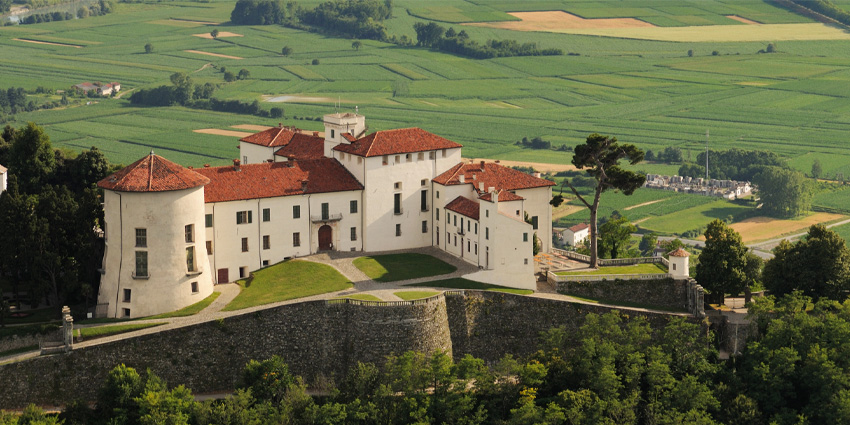
Masino Castle and Park: An Emotional Journey Through Time, Landscape, and Memory
Masino Castle and Park rise gently from the morainic hills of Ivrea, standing as a place where history does not merely exist—it lingers, breathes, and quietly accompanies those who cross its paths.
Perched above the Canavese landscape in Piedmont, Masino Castle is not only a historic residence but a living presence, deeply intertwined with the land, the seasons, and the passage of time.
Here, stone, greenery, and horizon merge into a single experience. The sense of arrival is subtle yet profound: the noise of the outside world softens, the rhythm of movement slows, and perception becomes more attentive. Masino does not impose itself; it invites contemplation.
The Historical Layers of Masino Castle
Masino Castle holds more than a thousand years of history, shaped by continuous transformation rather than rupture. Originally a medieval fortress, it gradually evolved into an elegant aristocratic residence, reflecting the changing tastes, ambitions, and sensibilities of the families who inhabited it. Each architectural layer remains visible, not as a contrast, but as a dialogue between eras.
Walking through the castle’s interiors reveals a refined intimacy. The rooms unfold with discretion, filled with frescoes, furnishings, libraries, and decorative details that speak softly of intellectual life, diplomacy, and private moments. Light filters through tall windows, settling gently on walls and floors worn smooth by centuries of presence. Nothing feels static; instead, the spaces seem suspended between remembrance and quiet continuity.
Masino Castle is not experienced as a monument frozen in time, but as a place where lived history still resonates—where silence carries meaning and every corridor suggests stories left intentionally unfinished.
Masino Park: A Landscape Designed for Emotion
Surrounding the castle, Masino Park extends across vast grounds, shaping an ever-changing landscape that feels both designed and spontaneous. This historic park is not merely ornamental; it is a space where nature becomes an emotional language. Formal gardens coexist with freer, more natural areas, allowing geometry and wilderness to balance one another.
Tree-lined avenues guide the gaze and the body, while open clearings offer moments of pause. The famous labyrinth, terraces, and panoramic viewpoints create a sequence of experiences rather than a single visual impression. From these elevated perspectives, the Piedmont countryside unfolds in wide, silent gestures, reinforcing a sense of openness and distance.
Each season transforms Masino Park into a different emotional landscape. Spring brings softness and renewal, summer deepens shadows and scents, autumn wraps the park in warm, introspective tones, and winter strips the scenery to its essential forms. In every phase, the park invites attentiveness, encouraging a slower, more reflective way of inhabiting space.
Architecture and Nature in Constant Dialogue
One of the defining qualities of Masino Castle and Park lies in the seamless relationship between architecture and nature. The castle does not dominate the landscape; it belongs to it. Terraces open toward the plains, gardens extend the architecture outward, and pathways frame views that feel carefully revealed rather than deliberately displayed.
This harmony creates a rare equilibrium. The built environment feels porous, open to light, wind, and seasonal change. The natural surroundings, in turn, seem shaped by human presence without being constrained by it. The result is a place where movement feels intuitive and observation becomes instinctive.
At Masino, time is not measured in minutes but in sensations: the shifting light, the sound of leaves, the gradual unfolding of perspectives.
A Sensory and Emotional Experience
Masino Castle and Park are experienced through the senses as much as through sight. The texture of ancient stone, the earthy scent of the park, the muted echo of footsteps within the castle halls—all contribute to a layered perception of place. Silence plays a central role, not as absence, but as a container for memory and awareness.
Emotion arises naturally, without spectacle. There is room for introspection, for quiet wonder, for a subtle awareness of continuity between human history and the natural world. The experience feels personal, almost intimate, despite the grandeur of the setting.
Masino encourages presence. It invites visitors to slow down, to notice, and to let the place speak without interruption.
Masino Castle as a Cultural and Landscape Landmark of Piedmont
Within the cultural and historical landscape of Piedmont, Masino Castle holds a distinctive role. Its value lies not only in its architectural and artistic heritage, but in its ability to preserve atmosphere, identity, and emotional depth. It stands as a testament to how heritage can be lived, not simply observed.
Masino Castle and Park remain in memory less as images than as sensations: a balance between intimacy and vastness, between history and nature, between thought and landscape. It is a place where time feels suspended, allowing past and present to coexist in a quiet, continuous exchange.