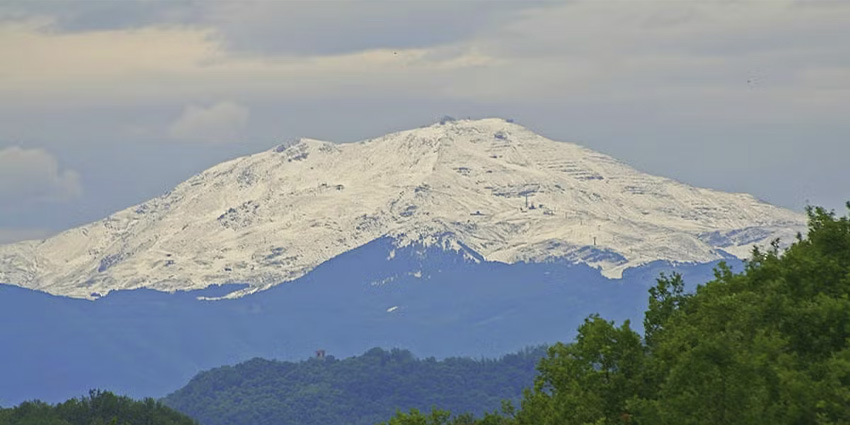
Monte Cimone: The Highest Breath of the Tuscan-Emilian Apennines
Monte Cimone is not merely a mountain peak. It is a presence that reveals itself slowly, an experience that unfolds with time and attention.
Rising to 2,165 meters, it stands as the highest summit of the Tuscan-Emilian Apennines, a natural threshold between sky and land, silence and memory, movement and stillness.
Here, altitude becomes more than a geographical fact. It transforms into a state of being. As the ascent progresses, the air grows lighter and clearer, carrying away the weight of everyday noise. The mountain invites a quieter rhythm, where each step seems to echo with intention and every pause feels meaningful.
A Landscape Shaped by Time
Monte Cimone speaks through its landscapes, using a language made of textures, light, and subtle transitions. At lower elevations, dense beech and fir forests envelop the path. Their canopy filters the sunlight, casting shifting shadows that move with the wind. The scent of leaves, damp earth, and resin lingers in the air, grounding the experience in something ancient and familiar.
Tree roots emerge from the soil like silent witnesses to centuries of seasonal cycles. They tell stories of endurance and balance, of growth shaped by harsh winters and gentle summers. The forest does not rush; it teaches patience simply by existing.
As the climb continues, the trees thin out and the horizon begins to open. Alpine meadows replace the woods, spreading wide and soft across the slopes. In spring and summer, these high-altitude grasslands are dotted with resilient wildflowers, their colors vivid yet never overwhelming. Yellows, purples, and whites appear briefly, flourishing in a landscape defined by wind and light.
The Summit: Where Space Expands
Reaching the summit of Monte Cimone is an experience marked by contrast. Physical effort gives way to an expansive calm. The view stretches outward in every direction, dissolving the sense of distance. On clear days, the Alps rise faintly on the northern horizon, while the Apennine ridge unfolds endlessly to the south, a continuous spine of land shaped by geological time.
The sky feels closer here. Clouds drift past at eye level, their shadows moving across the valleys below. The wind is a constant presence, firm but never hostile. It carries the essence of the mountain—cool, clean, and alive—reminding visitors that this is a place defined by motion and change.
Silence at the summit is never absolute. It is filled with subtle sounds: the rush of air, distant bird calls, the quiet rhythm of breathing. In this space, thoughts seem to slow, aligning with the vastness of the landscape.
Monte Cimone Through the Seasons
Each season transforms Monte Cimone, offering a different emotional landscape. Winter covers the mountain in snow, turning it into a luminous expanse where shapes soften and colors fade into white and blue. Sound becomes muted, and the mountain feels suspended, as if holding its breath beneath the cold sky.
Spring arrives cautiously at this altitude. Snow retreats in patches, revealing new life beneath. Water flows from melting ice, tracing temporary paths across the ground. The mountain awakens gradually, never abruptly.
Summer brings clarity and light. Long days allow for extended moments of observation, as clouds form in the valleys and dissolve under the sun. Even during the busiest months, Monte Cimone maintains a sense of openness and calm, offering solitude to those who seek it beyond the main paths.
Autumn introduces a gentle melancholy. Forests shift into warm tones of amber and rust, and the air grows sharper. The mountain feels introspective during this season, inviting slower movement and deeper attention. It is a time of reflection, where nature prepares for rest.
A Mountain of Memory and Presence
Monte Cimone carries the traces of human presence with quiet dignity. Along its slopes and near its summit, structures such as mountain shelters, observatories, and historical pathways appear discreetly, integrated into the environment rather than imposed upon it. These elements speak of observation, passage, and coexistence.
The mountain has long served as a point of reference—geographical, cultural, and emotional. Those who walk its paths today follow routes shaped by countless others before them, sharing the same sense of wonder and humility. Monte Cimone does not dominate; it allows itself to be encountered.
An Experience That Endures
Leaving Monte Cimone is not a moment of closure but a continuation. The experience lingers quietly, resurfacing in unexpected ways. It lives on in a deeper breath, in the memory of open horizons, in the recollection of wind against the skin.
Monte Cimone becomes a reference point within the mind—a reminder that vastness and stillness can coexist, that time can slow without stopping. Even far from its slopes, the mountain continues to speak, not through words, but through a lasting sense of clarity and calm.