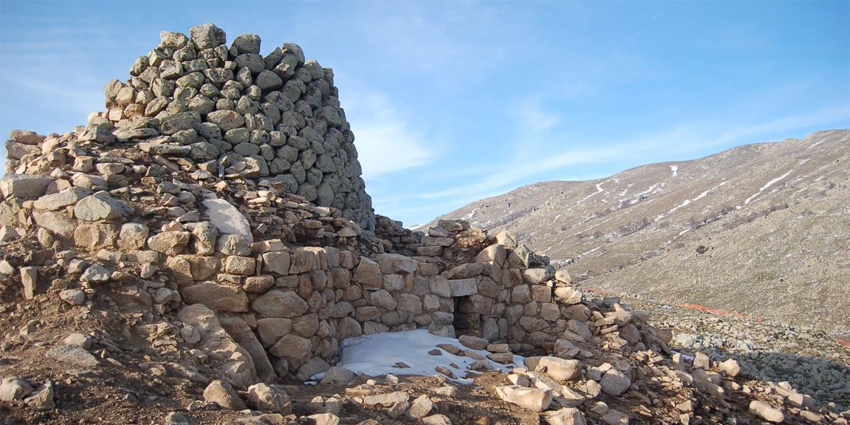
Nuraghe Ruinas
In the most authentic heart of Sardinia, where silence stretches across ancient landscapes and nature still speaks in a primordial voice, stands the majestic Nuraghe Ruinas.
More than a simple archaeological site, it feels like a living presence—an enduring echo of a distant past that continues to breathe through stone, wind, and light.
A journey beyond time and altitude
Reaching Nuraghe Ruinas is not merely about travel; it is about transition. The road climbs gently into the rugged highlands of central Sardinia, leading to the slopes of Mount Idolo at over 1,200 meters above sea level. Here, the air becomes thinner, purer, almost sacred. The horizon expands in every direction, revealing an untouched landscape of rolling hills, dense forests, and distant ridgelines fading into the sky.
This is one of the highest nuraghi on the island, and its elevated position creates a sense of detachment from the modern world. Standing before it, you feel as though you have crossed an invisible threshold—entering a space where time no longer moves in a straight line, but lingers, circles, and whispers.
The silent strength of ancient stone
Constructed from dark basalt blocks, Nuraghe Ruinas rises with a quiet authority. The stones, shaped and placed thousands of years ago, retain a raw, tactile presence. They absorb the warmth of the sun during the day and release it slowly, as if preserving the memory of light.
The central tower, still partially intact, speaks of resilience and human ingenuity. Despite centuries of exposure to wind, rain, and the shifting forces of nature, the structure endures—solid, grounded, almost defiant. Walking around it, you begin to notice subtle details: the precision of the masonry, the alignment of openings, the way shadows move across its surface throughout the day.
Each element seems intentional, suggesting that this was not merely a defensive stronghold, but perhaps a place of gathering, observation, or ritual.
The mystery of the Nuragic civilization
Nuraghe Ruinas is a powerful testament to the enigmatic Nuragic civilization, which flourished on the island between the Bronze and Iron Ages. Despite extensive research, much about this culture remains unknown, adding an aura of mystery to every site it left behind.
Standing within the presence of the nuraghe, it is easy to imagine the lives that once unfolded here—the rhythms of daily activity, the watchful gaze over the surrounding valleys, the communal moments shared within these stone walls. The structure becomes a silent narrator, offering fragments of a story that has yet to be fully understood.
An immersive emotional experience
Visiting Nuraghe Ruinas engages more than just sight—it awakens the senses. The wind moves freely across the plateau, carrying with it the scent of wild herbs and Mediterranean vegetation. The soundscape is minimal yet profound: rustling leaves, distant echoes, and the occasional cry of a bird cutting through the stillness.
There is a particular moment, often at sunset, when the entire site transforms. The golden light softens the harsh edges of the basalt, wrapping the structure in a warm glow. Shadows stretch across the الأرض, and the sky deepens into shades of amber and violet. In that fleeting interval, the nuraghe feels almost alive—no longer a relic, but a witness, quietly observing the passage of centuries.
Where nature and history converge
The environment surrounding Nuraghe Ruinas is as compelling as the structure itself. Dense woodlands, open clearings, and winding paths create a natural setting that enhances the sense of isolation and authenticity. There are no intrusive elements, no distractions—only the raw beauty of Sardinia’s inland territory.
Here, history is not confined to interpretation panels or guided explanations. It exists in the landscape, in the textures of the الأرض, in the interplay between light and stone. Every step invites a slower pace, encouraging reflection and a deeper awareness of place.
A timeless symbol of Sardinia’s soul
Among the thousands of nuraghi scattered across Sardinia, Nuraghe Ruinas stands apart—not only for its altitude and architectural presence, but for the emotional resonance it evokes. It embodies a version of Sardinia that remains untouched, authentic, and deeply connected to its roots.
To describe Nuraghe Ruinas is to attempt to capture something intangible. It is not simply a destination, nor just a historical landmark. It is an encounter—between past and present, between humanity and nature, between memory and imagination.
And long after leaving, the feeling lingers: a quiet awareness that somewhere, high among the Sardinian mountains, those ancient stones continue to stand, holding their stories in silence, waiting to be felt rather than explained.