Rocchetta Sant’Antonio: the village that preserves silence, memory, and horizon
There are places that are not simply visited, but gently experienced—like turning the fragile pages of an ancient book. Rocchetta Sant’Antonio,
nestled among the rolling heights of the Monti Dauni, is one of those rare villages where time has not stopped, but has chosen to move more slowly. Perched between sky and stone, it reveals itself gradually, offering not spectacle, but depth.
Located in northern Puglia, near the borders of Campania and Basilicata, this small hilltop town dominates a landscape that feels both vast and intimate. Its elevated position—over 600 meters above sea level—allows the eye to wander across endless hills, cultivated fields, and distant valleys shaped by centuries of wind and human presence.
A hilltop village overlooking three regions
Arriving in Rocchetta Sant’Antonio is already an emotional transition. The road climbs steadily, curves tighten, and the air becomes lighter and sharper. Suddenly, the compact silhouette of stone houses appears against the horizon. The village seems to rise organically from the earth itself, as though it had always belonged to that ridge.
From its panoramic viewpoints, the land stretches in soft layers of gold and green. Wheat fields shimmer under the sun, olive groves punctuate the slopes, and narrow rural roads trace delicate lines across the countryside. The changing light transforms the scenery throughout the day: pale and delicate at dawn, vibrant at midday, and glowing amber at sunset.
This geographical position has always given Rocchetta a strategic and cultural importance. It stands as a natural bridge between regions, yet it has preserved a strong and unmistakable identity rooted in the traditions of the Monti Dauni.
Medieval soul and timeless architecture
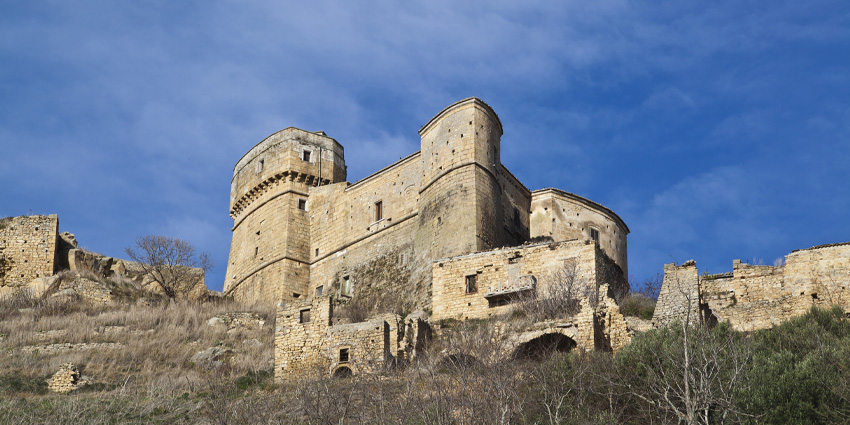
At the highest point of the village stands its castle, a silent guardian of history. The fortress watches over the clustered rooftops below, reminding visitors of the centuries in which Rocchetta Sant’Antonio played a defensive and administrative role in a borderland territory often marked by shifting powers and alliances.
Walking through the historic center feels like entering a living archive. Narrow alleys wind between stone façades. Arched passageways frame glimpses of distant hills. Staircases climb unexpectedly, connecting different layers of the village. Every architectural detail tells a story—carved doorways, wrought-iron balconies, weathered walls that carry the marks of time.
The churches scattered throughout the town add another layer to its narrative. Their interiors, often simple yet evocative, reflect a deep-rooted spirituality shaped by rural life. Bells echo across the valley, marking hours that feel unhurried, almost ceremonial.
Traditions rooted in land and community
In Rocchetta Sant’Antonio, traditions are not staged performances; they are part of everyday life. Religious celebrations follow the rhythm of the seasons, intertwining faith with agricultural cycles. Processions pass through the same streets that have witnessed generations before, connecting past and present in a continuous thread.
The culinary heritage of the village reflects the authenticity of its territory. Bread baked in traditional ovens carries the fragrance of ancient grains. Extra virgin olive oil, produced from surrounding groves, embodies the character of the land—robust, generous, and sincere. Handmade pasta, legumes, cheeses, and seasonal vegetables form the foundation of a cuisine born from necessity and transformed into cultural identity.
Meals here are not rushed. They are moments of gathering, conversation, and memory. Recipes are passed down quietly, preserved not in books but in gestures and shared experience.
Nature, silence, and the rhythm of wind
One of the most powerful impressions Rocchetta Sant’Antonio leaves is silence. It is not emptiness, but a living stillness filled with subtle sounds: wind moving through trees, distant footsteps on stone, church bells resonating across the hills.
The surrounding countryside invites slow exploration. Trails weave through open landscapes and wooded areas, offering encounters with untouched nature. The environment feels raw and genuine, far removed from mass tourism. Here, the land is not a backdrop but a presence—constant, protective, and grounding.
Situated within the province of Foggia, Rocchetta remains somewhat hidden from the more frequented coastal destinations of Puglia. This relative isolation has preserved its authenticity. The village does not seek attention; it simply exists, quietly confident in its identity.
Light, memory, and emotional connection
What makes Rocchetta Sant’Antonio unforgettable is not a single monument or attraction, but an atmosphere. It is the sensation of walking on stones polished by centuries of footsteps. It is the view of a sunset igniting the hills in shades of copper and rose. It is the warmth of conversations that unfold naturally in small squares and shaded corners.
The village offers a return to essential rhythms—those dictated by daylight, by seasons, by shared moments rather than schedules. The past is not a distant echo here; it is a foundation that continues to support daily life. The present unfolds gently, without urgency.
Rocchetta Sant’Antonio becomes, for many, more than a geographical destination. It transforms into a personal memory—a place associated with clarity, stillness, and authenticity. In its elevated quiet, between wind and horizon, visitors often rediscover something subtle yet profound: the beauty of slowness, the dignity of tradition, and the enduring connection between land and identity.
In the heart of the Monti Dauni, Rocchetta Sant’Antonio stands as a testament to the quiet strength of small Italian villages—where history breathes through stone, landscapes stretch beyond sight, and emotion lingers long after the journey ends.