Foligno: An Emotional Journey into the Green Heart of Umbria
In the vibrant center of Umbria, surrounded by rolling hills and luminous horizons, lies Foligno — a city that is not merely visited, but deeply felt.
To speak of Foligno is to describe an atmosphere, a rhythm, a quiet intensity that unfolds slowly through stone streets, Renaissance facades, sacred silences, and living traditions.
This is not just a destination in central Italy; it is an experience woven from light, memory, devotion, and authentic daily life.
Foligno, the “Center of the World”
Foligno proudly calls itself the “Center of the World.” The phrase is more than poetic imagery; it reflects both geographical centrality and a deeper symbolic meaning. In the heart of the historic center, a marker commemorates its central position within the Italian peninsula. Yet the true center of Foligno is not measured in coordinates — it is felt in its pulse.
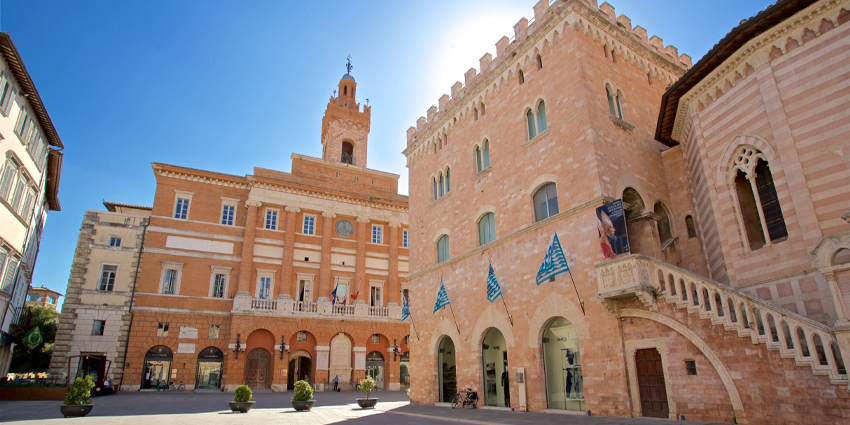
Everything converges in Piazza della Repubblica, the city’s living stage. Here, time seems to soften. Elegant historic buildings frame the square, outdoor cafés breathe life into its corners, and conversations drift lightly beneath open skies. The square is where past and present meet without tension, where footsteps echo softly against centuries of history.
Dominating the architectural scene is the majestic Palazzo Trinci, a Renaissance masterpiece whose frescoed halls narrate power, art, and human ambition. Walking through its rooms feels like entering a painted chronicle, where mythology, classical culture, and civic pride blend in harmonious detail.
Facing the square stands the imposing Cattedrale di San Feliciano, a Romanesque cathedral whose façade glows warmly at sunset. Inside, light filters through sacred space in a way that invites reflection rather than spectacle. The cathedral is not overwhelming — it is intimate, balanced, and profoundly human.
Spiritual Silence and Timeless Landscapes
Foligno’s soul is contemplative. Just beyond the city center, surrounded by olive groves and gentle slopes, rises the serene Abbazia di Sassovivo. The abbey’s Romanesque cloister is a masterpiece of geometric harmony, its arches framing the Umbrian countryside like living paintings.
Silence here is not emptiness; it is presence. The wind moves softly through the trees, distant bells resonate across the valley, and the landscape stretches in calm continuity. It is a place where time slows naturally, without effort.
This spiritual dimension is woven throughout Foligno. It lingers in narrow medieval alleys that suddenly open onto sunlit courtyards, in the subtle scent of warm stone during summer afternoons, and in the respectful quiet that seems to inhabit sacred spaces.
The Baroque Energy of the Quintana
While Foligno often whispers, it also knows how to ignite passion. Twice a year, the city transforms during the spectacular Giostra della Quintana, a Baroque historical joust that animates every corner of the historic center.
During the Quintana, Foligno becomes theatrical, vibrant, almost electric. Noble costumes shimmer in candlelight, drums reverberate through the streets, and horsemen gallop in a test of precision and honor. Each district, or rione, carries centuries of pride, expressed in colors, banners, and rituals passed down through generations.
It is not simply a historical reenactment; it is a collective emotion. The city breathes as one. The sound of footsteps on cobblestones intensifies. Anticipation fills the air. In those evenings, Foligno becomes a living bridge between centuries.
A Gastronomic Expression of the Land
Foligno’s cuisine speaks the language of Italy with a distinctly Umbrian accent: rustic yet refined, generous yet balanced. The flavors reflect the surrounding countryside — olive oil pressed from local groves, black truffles hidden beneath fertile soil, legumes cultivated with care, and full-bodied wines shaped by sun and patience.
Dining here is not hurried. Meals unfold slowly, allowing conversation and tradition to intertwine. Every dish carries memory — of farmers, of family kitchens, of seasonal rituals that define the rhythm of rural life.
The culinary identity of Foligno is deeply connected to its geography. It is a city that nourishes not only through taste but through authenticity.
Architecture, Resilience, and Renaissance Identity
Foligno’s story is also one of resilience. Throughout history, the city has faced earthquakes and reconstruction, yet it has consistently preserved its architectural identity. The Renaissance character remains visible in harmonious proportions, elegant palaces, and carefully restored facades.
Walking through its streets, one senses balance — between strength and grace, tradition and evolution. Foligno does not overwhelm visitors with grandeur; instead, it reveals itself gradually, detail by detail: an ancient doorway carved in stone, a hidden fresco above a quiet chapel, a sunlit balcony adorned with flowers.
The city’s urban design encourages exploration without haste. Each turn offers a discovery, each shadow a story.
Light as a Defining Element
There is something distinctive about the light in Foligno. It is soft but clear, golden yet delicate. In the late afternoon, the façades glow warmly, and the surrounding hills reflect subtle shades of green and amber. This light transforms the city into an ever-changing canvas.
It enhances the textures of stone, deepens architectural lines, and softens perspectives. It is perhaps this luminous quality that gives Foligno its emotional resonance — a sense of calm clarity that remains long after departure.
Foligno in the Heart of Central Italy
Situated in central Italy, Foligno holds a strategic and cultural position within Umbria. Yet beyond its geography, it represents a synthesis: spiritual depth without rigidity, artistic richness without excess, vitality without chaos.
It is a city that invites slow travel, mindful observation, and emotional presence. Here, history is not displayed behind glass; it lives within daily gestures, festivals, architecture, and shared spaces.
When leaving Foligno, something intangible lingers — perhaps the echo of distant bells, perhaps the warmth of the square at dusk, perhaps the quiet realization of having stood, if only briefly, at the symbolic center of something larger.
Foligno does not demand attention. It earns it — gently, steadily, memorably.