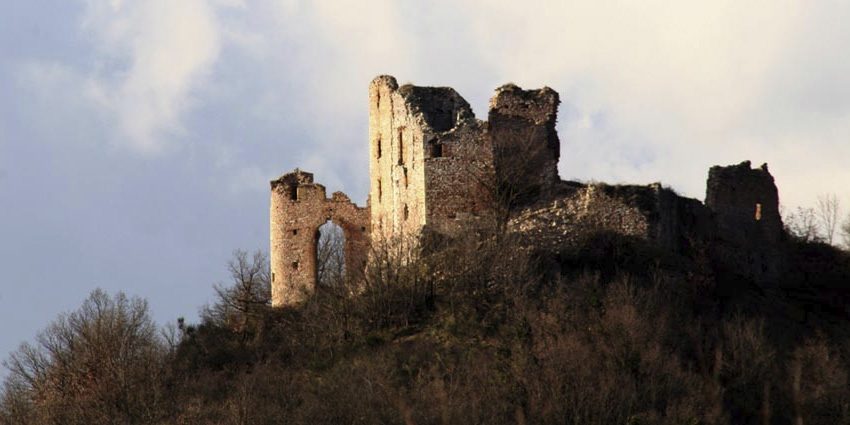
The Ruins of Castello dei Pecorari: A Journey into the Hidden History of Le Marche
There are places in Italy that seem to exist outside time.
You do not arrive there simply to see a monument; you arrive to experience a landscape, a story and the traces of people who lived there centuries before you.
That is exactly how I felt when I discovered the Ruins of Castello dei Pecorari, hidden among the hills near Piobbico, in the province of Pesaro and Urbino, Le Marche.
Perched on a small hill overlooking the Candigliano valley, the ruins are surrounded by woodland and countryside. From a distance, the remains of the medieval castle appear almost suspended above the landscape, which makes the approach feel like the beginning of a small adventure. Historical sources place the castle at around 550 metres above sea level, on the northern slopes of Monte Montiego.
A Medieval Castle Hidden in the Marche Landscape
What immediately struck me about Castello dei Pecorari was not its size, but its atmosphere.
Today, only parts of the original structure remain, yet the ruins still communicate the strategic importance of the site. The castle was positioned high above the valley, allowing those who occupied it to control and observe the surrounding territory.
The first documented mention dates back to 1216, when the castle was associated with the Brancaleoni family. Over the centuries, its history became connected with other important local powers, including the Ubaldini.
Standing among the remaining walls, it is easy to imagine how different this landscape must have looked during the Middle Ages.
Walking Towards the Ruins of Castello dei Pecorari
The experience is as much about the walk as the destination.
One of the documented approaches follows a route through woodland before reaching the hill on which the castle stands. A trekking itinerary to the castle is approximately 2.5 kilometres, with around 100 metres of elevation gain, and is classified as an easy hiking route.
As I approached the site, the vegetation gradually opened and the first fragments of masonry began to appear.
Then came the most evocative moment: the surviving arched entrance.
It is one of the best-preserved and most recognisable elements of the ruins. Beyond it, however, the remains become much more fragmented, with sections of walls scattered across the plateau.
There is something incredibly powerful about seeing history in this form. No polished rooms, no perfect towers and no museum displays—just stone, vegetation and silence.
A Castle Slowly Reclaimed by Nature
The history of Castello dei Pecorari is also a story of transformation and abandonment.
According to local historical accounts, the complex was partially dismantled around the 1930s, with some of its materials used for a rural building. Over time, the site fell into disuse and gradually became the evocative ruin that can be seen today.
Walking around the remains, I found myself paying attention to details that might normally be overlooked: a section of wall disappearing into vegetation, stones scattered across the ground, the shape of the surviving entrance and the way the ruins blend into the surrounding woodland.
This is not a castle preserved in perfect condition.
And perhaps that is precisely what makes it fascinating.
The Landscape Around the Castle
One of the most memorable aspects of the experience is the setting.
The castle stands above the Candigliano valley, with wooded hills and rural landscapes extending around it. Historical landscape documentation describes the hill as being covered by oak woodland and shrubland, reinforcing the feeling that the ruins are deeply connected to their natural surroundings.
From here, it becomes easy to understand why places like Castello dei Pecorari are so compelling for travellers interested in the quieter side of Italy.
This is not the Italy of crowded piazzas and famous monuments.
It is the Italy of forgotten paths, medieval stones, forests and landscapes that reveal their character slowly.
Why Castello dei Pecorari Is Worth Discovering
If you are travelling through Le Marche and enjoy history, hiking and lesser-known places, the ruins of Castello dei Pecorari offer a particularly atmospheric experience.
The site combines several elements in a single journey:
- Medieval history
- A scenic hilltop location
- Woodland trails
- Views over the Candigliano valley
- The remains of an ancient fortification
- A quieter alternative to Italy’s better-known castles
The route is relatively short, but the sense of discovery is much greater than the distance suggests.
One important point, however, is that these are ruins, not a restored tourist attraction. Some parts of the structure are unstable, and the documented hiking information recommends keeping a safe distance from the masonry.
A Different Way to Experience Italy
What stayed with me after visiting the Ruins of Castello dei Pecorari was the feeling of having encountered a fragment of Italy that has not been polished for tourism.
The stones tell only part of the story.
The rest is in the forest, the silence, the hill and the valley below.
And perhaps that is the real attraction of Castello dei Pecorari: you do not simply look at the ruins—you imagine what they once were.
For anyone exploring Piobbico and the lesser-known landscapes of Le Marche, this hidden medieval site can become one of those unexpected discoveries that remain in your memory long after the journey is over.
Sometimes, the most memorable Italian experiences are found by following the less obvious path.