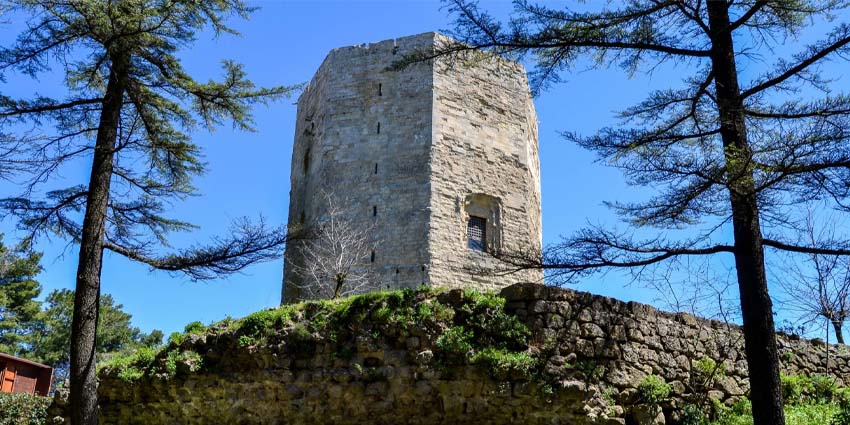
Torre Ottagonale, detta di Federico II: Stone, Silence, and an Imperial Vision
In the heart of authentic Puglia, where light falls sharply across endless olive groves and the wind glides through ancient walls like a timeless breath,
the Torre Ottagonale, known as the Tower of Frederick II, rises with quiet authority. Its geometric form, essential and powerful, tells a story that goes beyond medieval architecture. It is a fragment of an imperial vision, a symbol of balance between strength and intellect, between earthly dominion and philosophical aspiration.
Standing before it, one does not simply observe a structure of stone; one encounters an idea shaped into matter. The tower is not merely a relic of the past, but a living presence that continues to converse with the landscape, the sky, and the imagination of those who approach it.
The Meaning of the Octagon: Geometry as Philosophy
The octagonal shape is no coincidence. In medieval symbolism, the octagon represented mediation between the square—symbol of the earth—and the circle—symbol of divine perfection. The tower embodies this union. Each side, each precise angle, appears conceived not only for structural integrity but for conceptual harmony.
This geometry reflects the intellectual climate associated with Frederick II’s reign, an era in which science, mathematics, astronomy, and philosophy were interwoven with governance. The octagon becomes a silent declaration: power can be rational, beauty can be measured, and architecture can express thought.
Throughout the day, the pale stone transforms with the light. At dawn, it blushes with delicate pink hues. Under the midday sun, it becomes luminous, almost blinding in its clarity. At sunset, golden reflections stretch across its surfaces, while long shadows emphasize its sculptural presence. The tower does not simply stand in the landscape; it absorbs and mirrors the rhythm of the day.
Frederick II: The Emperor of Light and Knowledge
The tower is traditionally linked to Frederick II of Swabia, Holy Roman Emperor and King of Sicily, often called stupor mundi—the wonder of the world—for his extraordinary cultural openness and intellectual curiosity. In Puglia, he left an enduring architectural legacy: castles, fortifications, and strategic constructions that still testify to his ambition and refined aesthetic sensibility.
Frederick II was not a conventional medieval ruler. Fluent in multiple languages and fascinated by science, falconry, philosophy, and law, he envisioned an empire rooted not only in military strength but in cultural supremacy. The Torre Ottagonale fits into this broader narrative. Whether defensive outpost, watchtower, or symbolic structure, it expresses the fusion of strategy and intellect that characterized his reign.
Every stone seems to retain the echo of that vision—an empire organized through order, geometry, and calculated perspective. The tower becomes a metaphor for control over territory, but also over chaos: a fixed point in a vast, open land.
The Dialogue with the Apulian Landscape
Surrounding the tower, the countryside stretches wide and silent. The land undulates gently, dotted with olive trees whose twisted trunks speak of centuries of cultivation. Against this vastness, the octagonal profile emerges decisively yet harmoniously, as if it had always belonged to the terrain.
There is no sense of intrusion. Instead, the tower feels inscribed into the earth. Its proportions converse with the horizon; its vertical lines break the horizontal expanse of fields and sky, creating a visual tension that is both subtle and powerful.
On clear days, the horizon seems infinite. The tower becomes a visual anchor, an emotional center around which time appears to slow. The wind passing through its narrow openings produces a faint resonance—a whisper that suggests distant centuries, mounted sentinels, imperial courts, and the measured cadence of medieval life.
Between Defense and Symbol: An Enduring Mystery
One of the most compelling aspects of the Torre Ottagonale is the aura of mystery surrounding its original function. Was it primarily defensive? A strategic observation point? A symbolic architectural statement? The absence of definitive answers deepens its fascination.
Its thick walls evoke protection and solidity, while its openings toward the landscape invite contemplation. It is at once closed and open, guarded and receptive. This duality reflects the complexity of Frederick II’s reign: a period defined by military campaigns but also by intellectual expansion.
The rigor of its geometry suggests rational design, yet the atmosphere it generates is deeply emotional. Standing within its presence, one senses both discipline and poetry. The silence is dense but not oppressive; rather, it feels contemplative, as if the structure were encouraging introspection.
A Sensory Experience Rooted in Time
Approaching the Torre Ottagonale is a multisensory experience. The scent of dry earth and wild herbs carried by the breeze merges with the warmth radiating from the sunlit stone. Touching its surface reveals a texture smoothed by centuries, marked subtly by weather and time.
Footsteps around the base echo softly, absorbed by the open countryside. Voices lower instinctively, as though respecting an unspoken solemnity. The tower demands no spectacle; its presence alone is sufficient.
In this stillness, time seems layered rather than linear. The present moment coexists with imagined fragments of the past—watchful guards scanning the horizon, the calculated gaze of architects measuring proportions, the distant echo of imperial authority. The tower becomes not simply a monument, but a threshold between epochs.
Architectural Heritage and Cultural Identity
Today, the Torre Ottagonale, known as the Tower of Frederick II, represents an important element of Apulian historical heritage. It is a testament to the so-called “Frederician” architectural season, during which rational design, strategic placement, and symbolic geometry shaped the built environment of southern Italy.
Beyond its historical value, however, the tower embodies a broader cultural identity. It reflects a region that has long served as a crossroads of civilizations—Norman, Swabian, Byzantine, Arab—each leaving traces in language, art, and construction.
The octagon stands as a reminder that architecture can transcend function. It can articulate power without excess, evoke spirituality without ornament, and define territory through proportion rather than domination.
The Eternal Sentinel
Beneath the vast Apulian sky, the Torre Ottagonale remains immobile yet profoundly alive. It is a sentinel of time, a geometric meditation carved in stone. Its presence suggests that true strength lies not in noise but in balance, not in height alone but in harmony with what surrounds it.
As daylight fades and shadows lengthen across the fields, the tower seems to withdraw into contemplation. And yet, even in darkness, it persists—silent, composed, unwavering.
In the meeting of stone and sky, of geometry and landscape, the Torre Ottagonale, said to be of Frederick II, continues to guard its secret. It stands not only as a medieval structure in Puglia, but as a timeless expression of thought made architecture—an emotional encounter between history, light, and enduring vision.