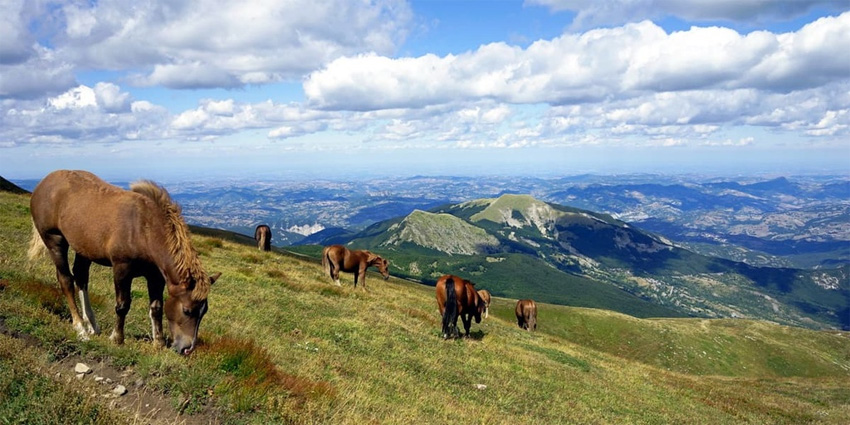
Tuscan-Emilian Apennines National Park: an emotional journey through nature, silence, and identity
The Tuscan-Emilian Apennines National Park is not simply a place to visit—it is a landscape to feel, to breathe in deeply, and to carry within.
Stretching across the border between Emilia-Romagna and Tuscany, this protected area represents a meeting point between wild nature, ancient history, and a deeply rooted mountain identity.
Here, the Apennines reveal their most authentic character: long ridgelines shaped by wind and time, vast forests, high-altitude meadows, and small villages that seem suspended between past and present. Every element contributes to a sense of balance that feels both fragile and enduring.
A landscape shaped by the rhythm of the seasons
In the Tuscan-Emilian Apennines National Park, nature constantly transforms itself. Spring brings a gentle awakening: wildflowers bloom across mountain pastures, streams swell with melting snow, and beech forests regain their soft, luminous green. The air feels lighter, filled with subtle scents of grass and damp earth.
Summer opens the horizon. Clear skies stretch endlessly above the ridges, and the light reveals wide panoramas where the land appears untouched. Even on warmer days, the forest offers shade and stillness, creating a sense of refuge and calm.
Autumn is perhaps the most emotional season. Forests ignite with shades of gold, copper, and deep red, turning paths into corridors of color. The sound of leaves underfoot becomes part of the experience, marking the slow passage of time. Winter, finally, wraps the park in silence. Snow reshapes the landscape, softening contours and restoring a primordial purity that invites contemplation.
Ancient forests and protected biodiversity
The forests of the Tuscan-Emilian Apennines are among the most extensive and well-preserved in Italy. Walking through beech woods, chestnut groves, and silver fir forests feels like entering a living archive of nature. Some areas are recognized as a UNESCO Biosphere Reserve, highlighting the ecological and cultural value of this territory.
Light filters gently through the branches, creating ever-changing patterns on the forest floor. Moss-covered stones, fallen leaves, and ancient tree trunks tell a story of continuity and resilience. The forest does not dominate—it welcomes, enveloping visitors in an atmosphere of quiet reflection.
Wildlife and the presence of the unseen
The Tuscan-Emilian Apennines National Park is home to a rich and balanced ecosystem. Among its most symbolic inhabitants is the Apennine wolf, a discreet and elusive presence that embodies the wild soul of the mountains. Alongside it live deer, roe deer, wild boar, golden eagles, and countless bird and insect species.
Wildlife here is often sensed rather than seen: a distant call echoing through the trees, fresh tracks along a trail, or a sudden movement in the undergrowth. These subtle encounters reinforce the feeling of being a guest in a living, breathing environment.
Lakes, ridges, and vast horizons
Mountain lakes such as Lago Santo, Lago Baccio, and Lago Scaffaiolo reflect the surrounding peaks with remarkable clarity. Their still waters mirror the sky, changing color with the light and weather. These places hold a quiet, magnetic beauty that encourages stillness.
The ridgelines of the Apennines offer wide, open views. On clear days, the gaze can reach as far as the Alps or the Tyrrhenian Sea. Wind shapes the grasses, clouds move quickly overhead, and the sense of openness creates a powerful connection between land and sky.
Mountain villages and enduring traditions
Scattered within and around the park are small mountain villages built of stone, shaped by centuries of coexistence with the land. These settlements preserve a strong sense of identity rooted in pastoral life, seasonal rhythms, and close community ties.
Ancient churches, narrow streets, and traditional architecture reflect a way of life adapted to the mountains. Local traditions, crafts, and cuisine are deeply linked to the environment, forming an inseparable part of the cultural landscape of the Tuscan-Emilian Apennines.
Silence as a defining element
One of the most distinctive features of the Tuscan-Emilian Apennines National Park is silence. Not an absence, but a presence—dense, comforting, and profound. It allows natural sounds to emerge clearly: the rustling of leaves, the flow of water, the distant cry of a bird of prey.
This silence creates space for introspection. It slows perception, encouraging a deeper awareness of the surroundings and of oneself. In a world increasingly dominated by noise and speed, the park offers a rare dimension of stillness.
A place that leaves a lasting impression
The Tuscan-Emilian Apennines National Park does not rely on dramatic spectacle. Its strength lies in subtlety, balance, and authenticity. The experience it offers is not confined to a single image, but to a collection of sensations: the scent of forests, the vastness of the ridges, the quiet persistence of mountain life.
It is a landscape shaped by time, where nature and human presence coexist gently, leaving traces that are light yet enduring—like footsteps along an ancient trail, slowly absorbed by the earth.